The restrict keyword in C is a forgotten keyword, with only auto and register more bygone. It is used as a compiler hint, to tell it that pointers does not write on each other, otherwise (without it) when multiple pointers are used in a function and some data is written, it has to reload the pointer each time because it cannot gurantee the pointer itself, or the data it points to was not modified.
Let’s see a simple example:
void copy_sum(int *dst, int *src, int *val, int n)
{
    for (int i = 0; i < n; i++)
    {
        dst[i] = src[i] + *val;
    }
}
The pointers dst and src could in theory point to overlapping memory, or even equal. The compiler can’t know they don’t overlap. So, inside the loop, after writing to dst[i], the compiler must assume that this write could have changed the memory pointed to by src (if dst equals src), and vice versa.
That means on every iteration, the compiler has to:
- reload the value of
dstandsrcfrom memory, instead of keeping them in registers (for potential aliasing), - maybe reload
*valas well, if it could alias to one of the other pointers.
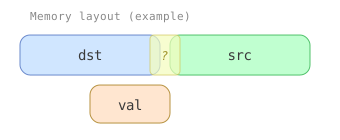
If we look at the optimized x86 assembly generated -
copy_sum:
        movq    %rdx, %r8
        testl   %ecx, %ecx
        jle     .L1
        movl    %ecx, %ecx
        xorl    %eax, %eax
        salq    $2, %rcx
.L3:
        movl    (%r8), %edx
        addl    (%rsi,%rax), %edx
        movl    %edx, (%rdi,%rax)
        addq    $4, %rax
        cmpq    %rax, %rcx
        jne     .L3
.L1:
        ret
Inside the loop, the compiler emits movl (%r8), %edx and addl (%rsi,%rax), %edx in every iteration. This means that every time through the loop, the compiler is reloading from val (*val) and from src[i] ((%rsi,%rax)).
Now all we change is this: (adding restrict)
void copy_sum_restrict(int *restrict dst, int *restrict src, int *restrict val, int n)
{
    for (int i = 0; i < n; i++)
    {
        dst[i] = src[i] + *val;
    }
}
We added restrict to every pointer. We basically told the compiler “you know what, addresses do not overlap”. Now the compiler does not have to reload, and it basically can start generting much more clever code.
copy_sum_restrict:
        movl    %ecx, %r8d
        testl   %ecx, %ecx
        jle     .L6
        leal    -1(%rcx), %eax
        movl    (%rdx), %r9d
        cmpl    $2, %eax
        jbe     .L11
        movl    %ecx, %edx
        movd    %r9d, %xmm2
        xorl    %eax, %eax
        shrl    $2, %edx
        pshufd  $0, %xmm2, %xmm1
        movl    %edx, %ecx
        salq    $4, %rcx
.L9:
        movdqu  (%rsi,%rax), %xmm0
        paddd   %xmm1, %xmm0
        movups  %xmm0, (%rdi,%rax)
        addq    $16, %rax
        cmpq    %rcx, %rax
        jne     .L9
        leal    0(,%rdx,4), %eax
        cmpl    %eax, %r8d
        je      .L6
.L10:
        movl    (%rsi,%rax,4), %edx
        addl    %r9d, %edx
        movl    %edx, (%rdi,%rax,4)
        addq    $1, %rax
        cmpl    %eax, %r8d
        jg      .L10
.L6:
        ret
.L11:
        xorl    %eax, %eax
        jmp     .L10
So the optimized code looks longer, which is quite odd, but the compiler is taking advantage of SSE2 vector instructions, which means it can process several array elements at once instead of one at a time.
All we did was change the type of the pointer, and the compiler was able to generate much more efficient code.
A benchmark shows that it does speedup things:
    Array size : 4194304 elements (16 MB per array)
    Iterations : 200 (+ 10 warmup)

    copy_sum (no restrict)           1.12 ms    28490.2 MB/s
    copy_sum_restrict                0.70 ms    45964.6 MB/s