This is part one of the Certificate Transparency series.
Certificate Transparency (CT) is a public, append-only logging system for TLS certificates. It was created to make certificate issuance observable so that mis-issuance can be detected quickly and independently. Instead of relying only on trust, CT lets anyone audit which certificates were issued for a domain and when they appeared in a public log.
The problem CT solves
Before CT, the certificate ecosystem had a fundamental trust problem: you had to trust that Certificate Authorities (CAs) were doing the right thing, but there was no easy way to verify it. If a CA issued a fraudulent certificate for instance through compromise or an error the only way to discover it was usually after the damage was done.
See for example DigiNotar, Comodo, and CCNIC incidents.
In all these cases, detection was slow, and pretty much relied on luck.
CT solves this by making certificate issuance public. Every publicly-trusted certificate must be logged to public, auditable logs before browsers will accept it.
So with CT:
- Domain owners can monitor logs for unexpected certificates.
- Researchers can analyze issuance patterns across the entire ecosystem.
- Mis-issuance becomes visible directly.
What Certificate Transparency is
Certificate Transparency is a set of public logs that accept certificates and return cryptographic proofs that the certificates were logged.
These logs are:
- Append-only: once a certificate is logged, it should remain in the log forever. Entries cannot be modified or deleted.
- Publicly auditable: anyone can verify log consistency and inclusion proofs. No authentication is required to read log contents.
- Operated by independent organizations to reduce single points of failure. No single entity controls all logs.
- Cryptographically verifiable: proofs are based on Merkle trees, so clients can verify claims without trusting the log operator.
The system also involves a few key actors:
- Certificate Authorities (CAs) submit certificates (or precertificates) to CT logs as part of their issuance process.
- Logs return Signed Certificate Timestamps (SCTs) — a signed promise that the certificate will be included in the log.
- Browsers require SCTs for publicly trusted certificates and enforce CT policy.
- Monitors watch the logs for suspicious or unexpected issuance and alert domain owners.
- Auditors verify that logs are behaving correctly and not omitting entries.
Understanding the Merkle tree
CT logs are built on Merkle trees, a data structure for cryptographic hashes.
What is a Merkle tree?
A Merkle tree is a binary tree where:
- Each leaf node contains the hash of a data item (in CT, a certificate).
- Each internal node contains the hash of its two children concatenated.
- The root hash represents a cryptographic commitment to all data in the tree.
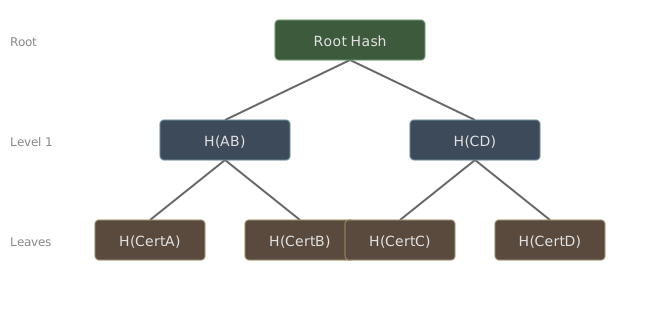
This structure enables two critical operations:
Inclusion proofs: Given a certificate, prove it exists in the log without downloading the entire log. You only need the hashes along the path from your leaf to the root—O(log n) hashes for a tree with n entries.
For example, to prove Cert B is in the tree above, you only need:
- H(A) — the sibling of H(B)
- H(CD) — the sibling of H(AB)
- The root hash
You can then verify: Root = H(H(H(A) || H(B)) || H(CD))
Consistency proofs: Prove that a newer version of the log is a valid extension of an older version—that no entries were modified or removed.
Tree head and signing
The log periodically publishes a Signed Tree Head (STH), which includes:
- The tree size (number of entries).
- A timestamp.
- The root hash.
- The log’s cryptographic signature over these values.
What gets logged
A typical X.509 certificate contains:
Subject and issuer information
- Subject Distinguished Name (DN): May include organization name, location, common name, etc.
- Issuer DN: Identifies the CA that issued the certificate.
Domain names
- Common Name (CN): The primary domain name .
- Subject Alternative Names (SANs): The authoritative list of domain names and IP addresses the certificate is valid for.
Example SANs might include:
DNS:example.com
DNS:www.example.com
DNS:api.example.com
DNS:staging.internal.example.com
DNS:10-0-1-42.pods.cluster.local
Validity period
- Not Before: When the certificate becomes valid.
- Not After: When the certificate expires.
Public key
The certificate’s public key is included.
Extensions
Various X.509 extensions including:
- Key usage constraints.
- Basic constraints (is this a CA certificate?).
- Certificate policies.
- Authority Information Access (where to find the issuer’s certificate and OCSP).
Certificates vs. precertificates
CT logs accept two types of entries:
Certificates
A standard X.509 certificate. Logging a certificate after issuance means the certificate can be used immediately.
Precertificates
A precertificate is a special certificate-like structure that:
- Contains all the same information as the final certificate.
- Includes a “poison” extension (OID 1.3.6.1.4.1.11129.2.4.3) that marks it as invalid for TLS.
- Is signed by either the issuing CA or a dedicated precertificate signing certificate.
The workflow with precertificates:
- CA creates a precertificate with all final certificate details.
- CA submits precertificate to CT logs.
- Logs return SCTs.
- CA creates the final certificate, embedding the SCTs.
- CA issues the final certificate to the subscriber.
This allows SCTs to be embedded directly in the certificate, which is the cleanest delivery mechanism.
The precertificate and final certificate will have identical information except:
- The poison extension is removed.
- The SCT list extension is added.
- The signature is different (covers the modified extensions).
When searching CT logs, you may find either or both versions of a certificate.
Signed Certificate Timestamps (SCTs)
An SCT is the log’s promise to include a certificate in the log. It contains:
- Log ID: SHA-256 hash of the log’s public key.
- Timestamp: When the log received the submission.
- Extensions: Reserved for future use (currently empty).
- Signature: The log’s signature over the above fields plus the certificate.
CT log APIs
CT logs expose an HTTP API. RFC 9162 defines the v2 endpoints:
Submission endpoint
POST /ct/v2/submit-entry
Submit a certificate or precertificate for logging. Returns an SCT.
{
  "submission": "base64-encoded-cert-or-precert",
  "type": 1,
  "chain": ["base64-encoded-issuer", ...]
}
The type field indicates what’s being submitted:
1for certificates (x509_entry_v2)2for precertificates (precert_entry_v2)
Query endpoints
GET /ct/v2/get-sth
Get the current Signed Tree Head.
Response:
{
  "tree_size": 123456789,
  "timestamp": 1705123456789,
  "sha256_root_hash": "base64-encoded-hash",
  "tree_head_signature": "base64-encoded-signature"
}
GET /ct/v2/get-sth-consistency?first=X&second=Y
Get a consistency proof between two tree sizes.
GET /ct/v2/get-proof-by-hash?hash=X&tree_size=Y
Get an inclusion proof for a leaf hash.
GET /ct/v2/get-entries?start=X&end=Y
Retrieve log entries by index. This is how monitors download certificates.
GET /ct/v2/get-all-by-hash?hash=X&tree_size=Y
Get both inclusion and consistency proofs in a single request.
GET /ct/v2/get-roots
Get the list of acceptable root certificates for this log.
crt.sh
crt.sh is a public website that aggregates data from CT logs into a searchable database. You can look up certificates by domain name, organization, or certificate hash. It’s a convenient way to explore what’s in the logs without querying them directly.
CT log operators
The CT ecosystem includes logs operated by multiple organizations:
| Operator | Notable Logs |
|---|---|
| Argon, Xenon, Icarus, Pilot, Rocketeer | |
| Cloudflare | Nimbus |
| DigiCert | Yeti, Nessie |
| Let’s Encrypt (ISRG) | Oak |
| Sectigo | Sabre, Mammoth |
| TrustAsia | Trust Asia Log |
Timeline and history
- 2011: DigiNotar indcident.
- 2013: RFC 6962 published; Google launches pilot logs.
- 2015: Chrome begins requiring CT for EV certificates.
- 2018: Chrome requires CT for all new certificates (April 30).
- 2021: RFC 9162 published.
- Present: CT is mandatory for all publicly-trusted certificates in major browsers.